



















































How Many Laser Hair Removal Sessions Do You Actually Need?
If you’ve researched laser hair removal for more than five minutes, you’ve probably encountered answers that range from “six sessions” to “it depends” to timelines that don’t actually tell you anything useful. The honest answer is more specific than most content on this topic gives you credit for, and it starts with the clinical standard.
According to StatPearls, published through the National Institutes of Health, the minimum required to achieve adequate results is 4 to 6 sessions spaced 4 to 6 weeks apart. For most patients treating most body areas, that range holds.
Where individual results vary is in how quickly you move through it, what affects your specific number, and what maintenance looks like once the initial course is complete.
The 4 to 6 session standard is the clinical floor, not a ceiling. Most patients treating common areas like the legs, underarms, or bikini line land somewhere in that range and see their best results by the end of it. Some areas and some hair types require additional sessions, and the maintenance phase that follows is a real part of the plan, typically once every 6 to 12 months after the initial course is complete.
What makes laser hair removal in Boca Raton and Fort Lauderdale worth planning for is understanding that the session range is a starting point, not a promise. Your number depends on several variables, and knowing them helps you set realistic expectations from the beginning.
Hair grows in three phases: anagen (active growth), catagen (transition), and telogen (resting). Laser energy is only effective against hairs in the anagen phase, because that is when the follicle is most connected to the root and most responsive to heat-based disruption.
At any given moment, only a portion of your hairs are in anagen. The percentage varies by body area and individual biology, which is one of the reasons treatment timelines differ from person to person.
Sessions spaced 4 to 6 weeks apart are designed to catch successive waves of hairs as they enter the anagen phase, systematically reducing the active follicle count over time.
This is why spacing is as important as session count. Rushing treatments or extending the gap between sessions works against the biology that makes laser hair removal effective in the first place.
Several variables determine where you land in the range and how quickly you see results.
Skin tone and hair color have the most direct impact. Laser treatments work by targeting melanin in the hair follicle. Dark hair on lighter skin provides the clearest contrast, typically resulting in faster reduction and fewer sessions. Lighter or finer hair requires more precision and more sessions to achieve the same outcome.
Darker skin tones require specific laser wavelengths and precise calibration to treat effectively without affecting surrounding skin, which is where provider expertise and technology make a measurable difference.
Treatment area plays a significant role as well. The underarms and bikini line tend to respond quickly, often showing meaningful reduction within the first few sessions. Legs and arms generally follow a predictable arc through the full course.
Facial areas, particularly the chin and upper lip, are more variable because hormonal activity directly influences hair growth there. For patients in their 40s and 50s navigating perimenopause or hormonal birth control changes, facial hair may require additional sessions and more consistent maintenance over time.
Hair thickness and density also affect the timeline. Coarser, denser hair requires more sessions to fully address all active follicles. Finer hair typically responds faster and may reach its best result within the lower end of the session range.
Knowing what to expect at each stage makes the process easier to stay committed to.
After sessions one and two, most patients notice initial shedding and treated areas beginning to thin. This is the laser disrupting the first wave of anagen-phase follicles. Skin is clearing what was treated, which can sometimes look like continued growth before the shed begins.
By sessions three and four, reduction is visible and measurable for most patients. Body areas with dense hair show clear improvement. Regrowth tends to come in finer and slower than before treatment started.
Sessions five and six bring most patients to their best result. Hair in treated areas is significantly reduced, with only scattered regrowth remaining. For some patients, this is where the initial course concludes. Others may benefit from one or two additional sessions depending on their response and goals.
Maintenance sessions, recommended once every 6 to 12 months, address newly activated follicles and keep results consistent over the long term.
In Boca Raton and Fort Lauderdale, sun exposure is not a seasonal consideration. It is a year-round reality. This matters for laser hair removal because treated skin is more photosensitive in the days surrounding each session, and sun exposure during that window increases the risk of irritation and unwanted pigmentation changes.
For South Florida patients, building a realistic treatment timeline means accounting for outdoor lifestyle and consistent UV exposure in a way that simply does not apply in most other markets. For patients with existing skin discoloration concerns or a history of sun sensitivity, session spacing and aftercare require extra attention.
Our team factors all of this into your plan from the first consultation, so your timeline works with your life rather than against it.
Sanctuary Medical Aesthetic Center has been serving patients in Boca Raton and Fort Lauderdale since 2006, with two South Florida locations and a team that includes board-certified plastic surgeons, board-certified dermatologists, physician assistants, nurse practitioners, and licensed medical aestheticians.
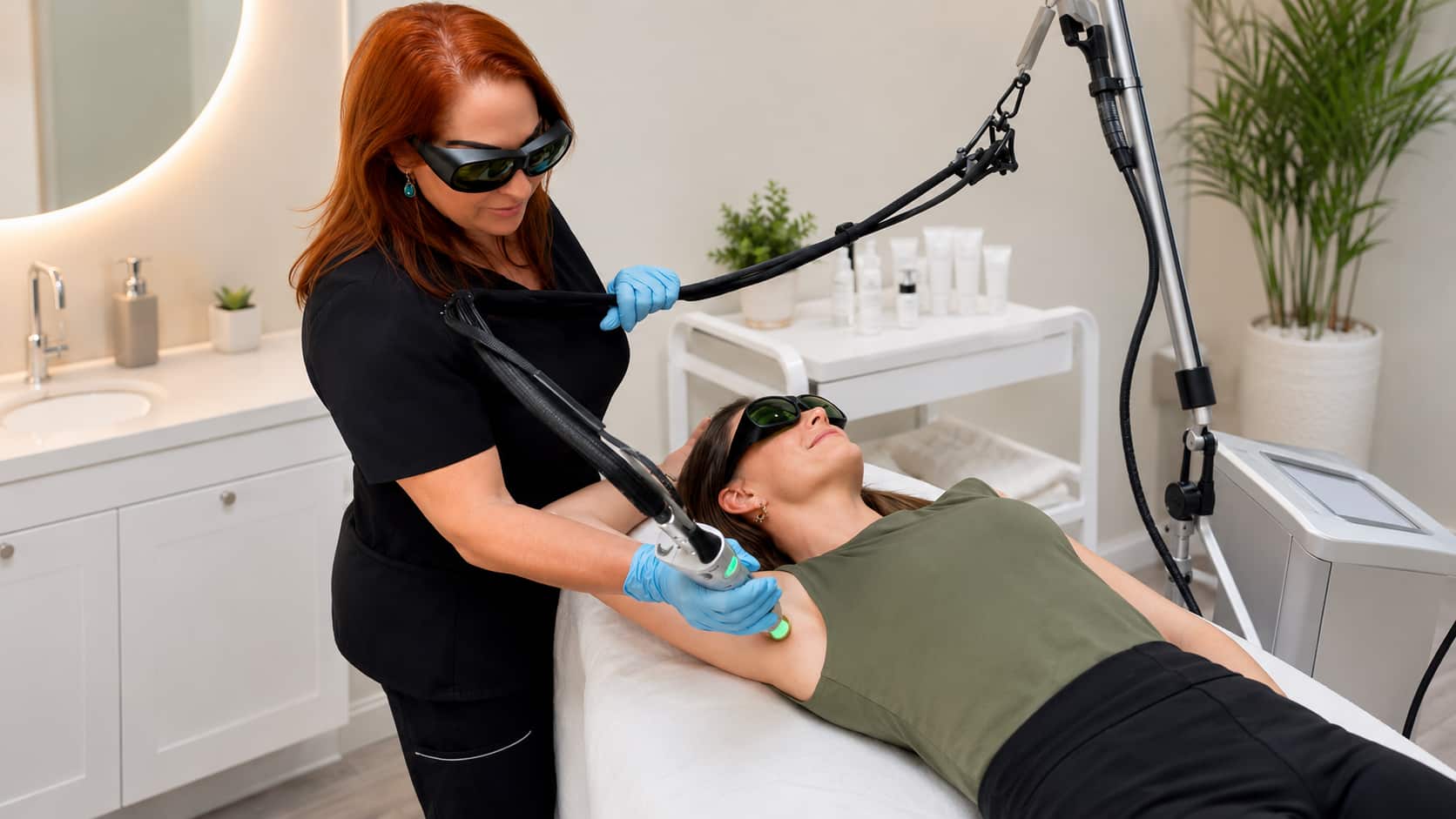
As home to the largest laser facility in the southeast region, we have the technology and clinical depth to build a plan around your specific skin tone, hair color, treatment area, and lifestyle. Our providers use the GentleMax Pro, a dual-wavelength laser that allows precise calibration across a wide range of skin types, including the diverse skin tones that South Florida patients bring in. Every session count recommendation we make is built around what we see in front of us, not a fixed number handed to every patient the same way.
The only way to know your number is a consultation with a qualified provider. Our team at Sanctuary Medical Aesthetic Center will assess your skin type, hair color, treatment area, and goals, and give you a clear, realistic plan before your first session begins.
Book your appointment and let us give you the honest answer.